
Quick answer
Ask a grandparent, older relative, caregiver, or trusted adult one concrete question about childhood or a shared memory. Choose or create a coloring page around the answer, let the child add personal details without copying an adult sample, and write the person's words or the child's explanation on the back.
- Start with one specific memory instead of a generic best-grandparent certificate.
- Make room for grandparents, kinship caregivers, older relatives, family friends, and other important adults.
- Let the child decide how much to color, draw, dictate, or write.
- Ask permission before using a photo, recording a conversation, or sharing the finished page.
Choose a person before choosing the page
The federal observance is the first Sunday after Labor Day, which is September 13 in 2026. A family can mark it on that date or choose any day that makes an unhurried visit or call possible. Schools and child care programs should avoid building the activity around one required family structure. Some children live with grandparents, some see them occasionally, some connect from a distance, and some cannot or do not want to make a grandparent-themed gift.
Offer a wider invitation: think of a grandparent, older relative, kinship caregiver, neighbor, family friend, or another adult who has shared a story or taught you something. A child can also make a page about a family story without naming one recipient. This keeps the work personal while giving children a private, ordinary way to participate when family relationships are complicated.
Ask one question that can become a picture
Broad prompts such as “Tell me about your childhood” can be hard to answer on demand. A small question is easier to enter and more likely to produce a scene a child can draw or color. Reading Rockets recommends preparing questions, practicing the interview, and letting young children interview family members or ask another relative about a grandparent who cannot be interviewed. It also advises getting the interviewee's permission before using an oral history.
For preschoolers, an adult can ask the question and write down one sentence exactly as it was said. Elementary-age children can pick two questions, take short notes, and circle the detail they want to illustrate. The conversation does not need to sound formal, and it does not need to be recorded. Listening carefully is enough.
- What game did you like when you were my age?
- What did you cook, grow, build, collect, or fix with someone in your family?
- Where was your favorite place to read, play, or spend a quiet afternoon?
- What animal, vehicle, song, or silly story do you still remember?
- What is something we enjoy doing together now?
Turn the answer into a scene
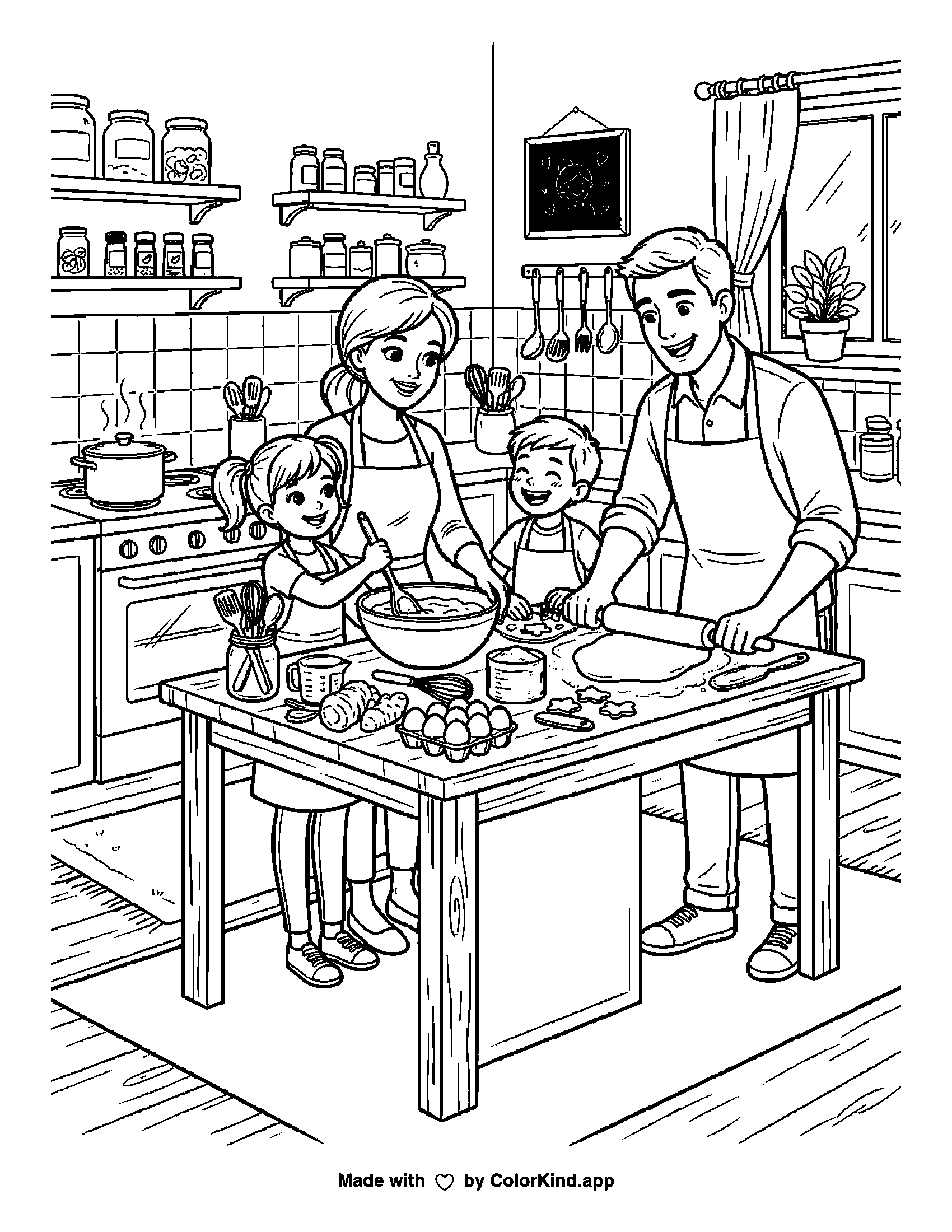
Pull out a person, action, and place from the answer. “I picked tomatoes with my aunt behind her apartment” can become two relatives filling a basket in a small garden. “We always read on the couch with the dog” can become a child, an older adult, a book, and a sleepy pet. Keep the request simple enough that the child still has room to add the tomato vines, book cover, wallpaper, weather, or other remembered details.
A ready-made family page works when the shared activity is common, such as reading, cooking, walking, or gardening. For a more particular memory, ColorKind is free to try on iPhone and iPad. Describe the relationship rather than requesting a real person's name in the artwork, since generated lettering can be unreliable. A prompt such as “a child and their grandpa repairing a red bicycle in a garage, simple coloring page” carries more of the story than a generic holiday message.
| Memory detail | Scene idea | A child could add |
|---|---|---|
| A favorite after-school snack | Two people cooking at a kitchen counter | The bowl, plate pattern, or family recipe name on the back |
| A garden or farm job | An older adult and child gathering vegetables | Plants, tools, weather, or an animal that visited |
| A song or bedtime story | Two people reading or making music together | Notes, stars, a lamp, or an imagined story character |
| A first car or bike | A simple vehicle beside the people who remember it | Its color, a destination, or what was carried |
| A long-distance routine | Two homes connected by a phone or video call | The greeting, pet, snack, or object that appears on every call |
Use a photo when the photograph is part of the memory
A family photograph can become the starting page, especially when the child wants to color a recognizable person, pet, kitchen, garden, or vacation moment. Ask the people pictured before turning it into a page or sharing the result. Choose a clear photo with one main moment; a close, well-lit subject generally gives cleaner line art than a distant group in a crowded room.
The child can color from memory rather than matching the photograph. They might change everyone's clothes, add a missing relative, move the event outdoors, or put the family dog into the scene. If the source photo includes a school name, address, badge, license plate, or another private detail, crop it out first and review the generated page before printing.
Let the child make the keepsake
A keepsake does not need matching colors, perfect handwriting, or complete coverage. NAEYC's guidance on process-focused art recommends skipping the adult sample, leaving room for choice, noticing what the child actually did, and letting the child decide whether the work goes home or stays in the classroom. A printed outline can still support that kind of choice when it is treated as a starting point rather than a pattern to copy.
Put out a small range of crayons or pencils, blank paper, and the chosen page. Invite the child to add one remembered object or a new detail, but do not fix the drawing. Ask a descriptive question only if the child wants to talk: “I see three bowls on the table. Who uses them?” Write the answer on a removable note or the back so the child's marks stay untouched.
- Read back the one sentence or memory chosen for the page.
- Let the child pick the page, colors, and place to begin.
- Offer blank paper if they would rather draw the whole scene themselves.
- Invite one personal addition without requiring it.
- Ask whether the child wants their words written on the back.
- Let the child decide whether to give, mail, display, or keep the page.
Add the story without crowding the artwork
The back of the page is a better home for the story than a crowded front. Write the date, the storyteller's name as they want it shown, the child's name if appropriate, and one or two sentences from the conversation. Reading Rockets describes photographs, letters, journals, and other artifacts as useful companions to oral histories, with permission. A copied recipe, photo print, or short note can travel with the coloring page in a folder or envelope.
Preserve the speaker's wording instead of polishing it into an adult essay. “Grandma Jo says the goat ate her mitten” has a person and a surprise in it. That is enough. If a classroom plans to display or publish family stories, obtain permission and give every child a private take-home option. Home-language answers can stay in the home language, appear with a translation, or be dictated to an adult.
Adapt it for home, preschool, or elementary school
At home, the entire activity can happen during one visit or phone call: ask a question, color together, and put the answer on the back. ZERO TO THREE suggests sharing childhood games, places, pets, songs, and family traditions with young children, and reminds adults not to rush the shared process. It is fine if the page remains unfinished when the conversation moves somewhere else.
In preschool, collect family responses in advance with an opt-in note, then offer several broad scenes and blank paper. A teacher can transcribe the child's explanation without correcting it. In elementary school, let students practice questions in pairs, conduct a short interview at home or with a school-approved community adult, and make an illustrated memory page. Never grade the closeness of the relationship, the amount of family information disclosed, or the artistic result.
Finish it simply
Print one test page before making a classroom set. Ordinary printer paper works for crayons and colored pencils; a slightly heavier sheet can feel sturdier for a mailed gift if the printer supports it. Leave the back blank until the coloring is finished, then add the story with a dark pen or attach a separate note.
Avoid piling on a certificate, poem, questionnaire, frame, and gift tag. One picture plus one true sentence is easier for a child to finish and more interesting to receive. The result records what these two people talked about on one particular day, which is what makes it worth keeping.
Frequently asked questions
When is Grandparents Day in 2026?
National Grandparents Day is Sunday, September 13, 2026, in the United States. Federal law designates the first Sunday after Labor Day. Families and schools can choose another date when it makes participation easier.
What can a child make if they do not have a grandparent to interview?
Invite them to choose an older relative, kinship caregiver, neighbor, family friend, or another trusted adult. They can also illustrate a family story without naming a recipient or choose a different creative activity privately.
What should a preschooler put on a Grandparents Day coloring page?
Start with one large scene from a shared routine, such as reading, cooking, walking, gardening, or talking on the phone. Let the child add one remembered object while an adult writes their explanation on the back.
Can a family turn a grandparent photo into a coloring page?
Yes, with the pictured person's permission. Use a clear photo with a close subject, crop identifying details that do not belong in the activity, and review the line art before printing or sharing it.