
Quick answer
Keep the walk short and give it one noticing job: find three leaf shapes, match outdoor colors, listen for movement, or revisit one tree. Back inside, make a rubbing, sketch the object, choose a related printable, or create a simple coloring scene from the child's own description.
- Choose one observation prompt instead of handing children a long scavenger-hunt checklist.
- Look closely before collecting, and follow the rules for the park, schoolyard, or other place you visit.
- Use the page to remember and investigate the walk, not to test whether a child can name every plant.
- Let children choose between rubbing, drawing, coloring, dictating, and leaving the page unfinished.
Give the walk one small purpose
“Find everything about fall” is too broad for most young children. Pick one question that can be answered within ten or fifteen minutes: How many leaf edges can we find? What is moving in the wind? Which colors appear on the ground? What has changed since our last walk? A narrow question slows the group down without turning the outing into a quiz.
The National Association for the Education of Young Children suggests asking what looks different today, bringing paper and crayons for drawing, and using a magnifier to inspect small details. Its outdoor exploration ideas also invite children to compare leaf shapes, colors, textures, and veins. Those prompts work in a yard, on a school path, beside an apartment building, or through a window when a longer outing is not possible.
Tell children there may be several good answers. One child may notice a red leaf while another studies a wet footprint or the sound of a truck passing through dry leaves. The shared question holds the activity together; everyone does not need to bring back the same result.
Choose a walk that fits the group
For a preschool class, the useful route may be one lap of the playground with two stopping places. At home, it might be the path to the mailbox. An elementary group can compare two trees on school grounds or map where leaves gather after wind. Distance matters less than having time to stop safely and hear what children are noticing.
Check the route, weather, and local rules first. On public land, stay on designated paths and leave wildlife alone. The U.S. Forest Service advises visitors to check conditions, dress for changing weather, bring water, remain aware of their surroundings, and observe animals without approaching or feeding them. For a neighborhood walk, add the ordinary rules your group needs around driveways, street crossings, unfamiliar plants, and adult boundaries.
Collecting is optional. A photograph, quick sketch, spoken description, or teacher note can preserve an observation without taking anything. If collecting is allowed, choose a few common fallen items rather than pulling leaves or flowers from living plants. Wash hands after the walk, especially before eating.
Try one of four noticing activities
The activity should leave room to look around. A clipboard packed with boxes can make children stare at the list instead of the place. Give each pair one card, or introduce one prompt aloud and keep your own short notes for later.
| Noticing job | What to bring | What to do afterward |
|---|---|---|
| Find three different leaf edges | Paper and one unwrapped crayon | Make rubbings or draw the outlines side by side |
| Match colors without naming them | A few crayons or color swatches | Circle the closest match and invent a name for it |
| Listen for something moving | Nothing | Draw what made the sound or what the child imagined |
| Revisit one tree | Camera or small notebook | Color the same simple tree outline after each visit |
Leaf-edge hunt
Search the ground for leaves with smooth, toothed, wavy, or deeply cut edges. Children do not need the botanical names. Ask them to sort the shapes in a way that makes sense to them, then explain their groups. If you can take fallen leaves, carry only what you will use and follow the site's directions for composting or disposal afterward.
Color-match walk
Bring a small handful of crayons and look for near matches. The point is not to prove that a leaf is exactly burnt orange. Compare two possibilities and talk about where the color changes. A child might name the shades “toast edge,” “rainy red,” or “muddy gold,” which is more memorable than supplying the adult answer.
Sound-to-picture walk
Pause for thirty quiet seconds. Listen for leaves scraping, a squirrel moving, shoes on gravel, wind, birds, or city sounds. Back inside, the child can draw the source or invent a scene around it. This option works well when there are few changing leaves or when touching plants is not safe.
Turn an observation into a coloring page
Start with the child's words, not a polished adult prompt. Ask what they want to remember, who or what should be in the picture, and where the action happens. “The tiny yellow leaf spun beside the drain” is enough for a scene. Preserve that odd, specific detail instead of replacing it with a generic fall festival.
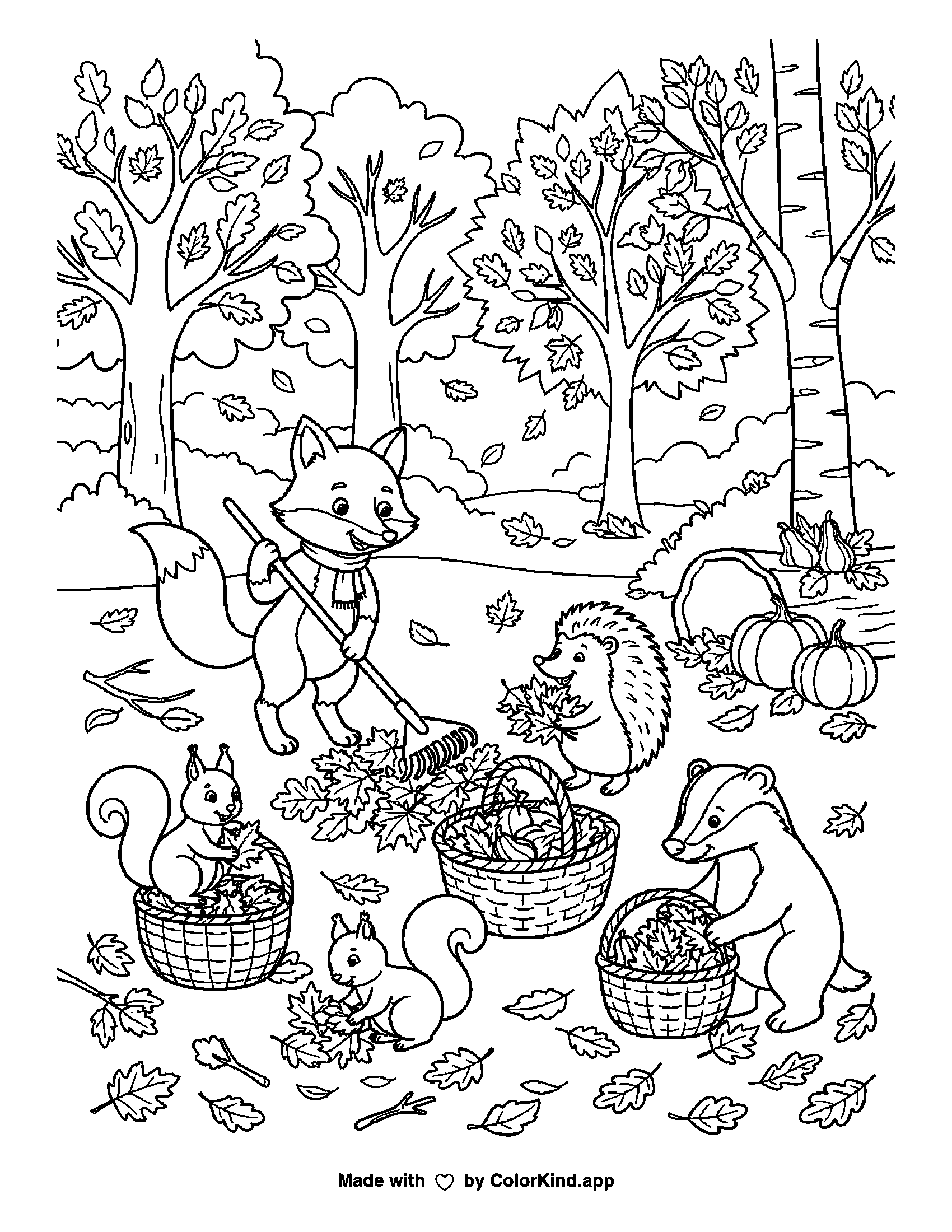
A ready-made page can reopen the conversation. The free Birds Collecting Autumn Leaves page, for example, can lead to questions about which leaves the child saw, where the birds might carry them, and what colors belong in the child's version. The picture does not have to document the walk literally. It can mix observation with a story.
For a custom scene, ColorKind is free to try on iPhone and iPad. Keep the request short: “two children comparing wavy and pointy fallen leaves under one big tree, simple coloring page.” Review the result before printing, then invite the child to add the missing parts. A drain, bench, backpack, cloud, or invented animal may be the detail that makes the page theirs.
Make a leaf rubbing without taking over
NAEYC describes a simple rubbing method: place paper over a leaf on a hard surface and rub the side of a crayon across it so the veins and edge appear. Dry, fairly flat leaves are easier to use than curled or damp ones. If outdoor collecting is not allowed, make the rubbing at the spot with adult supervision, use a leaf from home, or trace around a photograph instead.
Tape the paper lightly if it slides, but let the child decide the pressure, colors, and overlap. The first attempt may reveal only half a leaf. That is useful information about where the veins sit and how hard the crayon touched the page. Put another sheet nearby rather than finishing the rubbing for them.
- Place one dry leaf vein-side up on a firm table.
- Lay ordinary paper over it and hold the corners gently.
- Peel the paper wrapper from one crayon and use the long side, not the tip.
- Rub lightly, then add pressure only where the shape is hard to see.
- Compare the rubbing with the leaf and add any detail the child notices.
Adapt the activity for different ages and settings
Toddlers can carry a color card, point to one changing thing, and make broad crayon marks afterward. Preschoolers can compare two leaves, make a rubbing, or dictate a sentence. Elementary-age children can revisit the same tree, label a few observations, and build a small sequence showing change over time. These are options, not a ladder every child must climb.
In a daycare or after-school program, split a large group into small noticing teams with the same boundary and different prompts. One team listens, one studies shapes, and one looks for color changes. Back indoors, children can share discoveries through pictures instead of a required presentation. Display work only with permission and leave names off public-facing photographs.
Offer a page with open spaces, a more detailed page, and blank paper. Some children will want to color while they tell the story; others will sketch first or spend the whole period arranging leaves. The guide to choosing coloring-page difficulty can help adults judge visual density without attaching a skill label to the child.
Keep a record worth revisiting
Write the date, place, weather, and the child's own sentence on the back. Save one page rather than every scrap. Return to the same short route in two or three weeks, then put the new page beside the first. NAEYC specifically recommends watching one tree through the seasons and noticing leaves, buds, insects, birds, and other visitors.
Resist correcting the colors to match a fall palette. In many places, August and September are still green; in others, leaves change without becoming bright red or orange. The record should show what the child saw or imagined on that day. A green tree, brown seedpod, gray sidewalk, and impossible purple squirrel can all belong on the same page.
For a classroom set, print one test copy before the walk and leave plenty of room for additions. The printing guide covers AirPrint and margin fixes, while the paper guide can help if children will use crayons, pencils, or markers. Then stop planning. One question, one walk, and one page are enough.
Frequently asked questions
What should children bring on a fall nature walk?
For a short familiar route, bring weather-appropriate clothing, water, one sheet of paper, and a crayon or pencil. An adult should check local conditions and rules. Longer or less familiar outings need route-specific preparation.
Can children collect leaves in a park?
Rules vary by location, so check before collecting. A photo, sketch, or on-site rubbing is a good alternative. When collecting is allowed, take only a few common fallen items and leave living plants and wildlife alone.
What if the leaves have not changed color?
Look at edges, veins, movement, shadows, seedpods, bark, sounds, or changes in one familiar tree. Fall observation does not require red and orange foliage.
How can a teacher use fall coloring pages after a nature walk?
Ask students to add one observed detail to a related page, compare leaf shapes, illustrate a sound, or color the same tree outline after repeated visits. Keep sharing optional and accept drawing or dictation as alternatives.