
Quick answer
Set out three to five page choices at different detail levels, keep materials within reach, provide a folder for unfinished work, and teach a three-part routine: check the assigned task, choose from the approved menu, then stop and store work when the class transitions.
- Coloring should be one early-finisher option, not a reward reserved only for the fastest students.
- A small rotating selection is easier to manage than an overflowing binder.
- Students need an explicit stopping routine because many pages will remain unfinished.
- Blank paper and non-coloring choices keep the routine flexible and inclusive.
Decide what the routine is meant to solve
An early-finisher routine should protect learning time for the whole class. Students who finish should know what to check, what they may choose, how quietly they should work, and what happens when the group is ready to move on. The routine also needs to avoid encouraging rushed work just to reach a preferred activity.
Coloring fits well as one calm choice because it can be paused without losing progress, requires little explanation once materials are organized, and can connect to a book, unit, season, or student interest. It should sit beside other legitimate choices such as reading, drawing, completing unfinished work, or a teacher-approved extension.
Build a station students can use independently
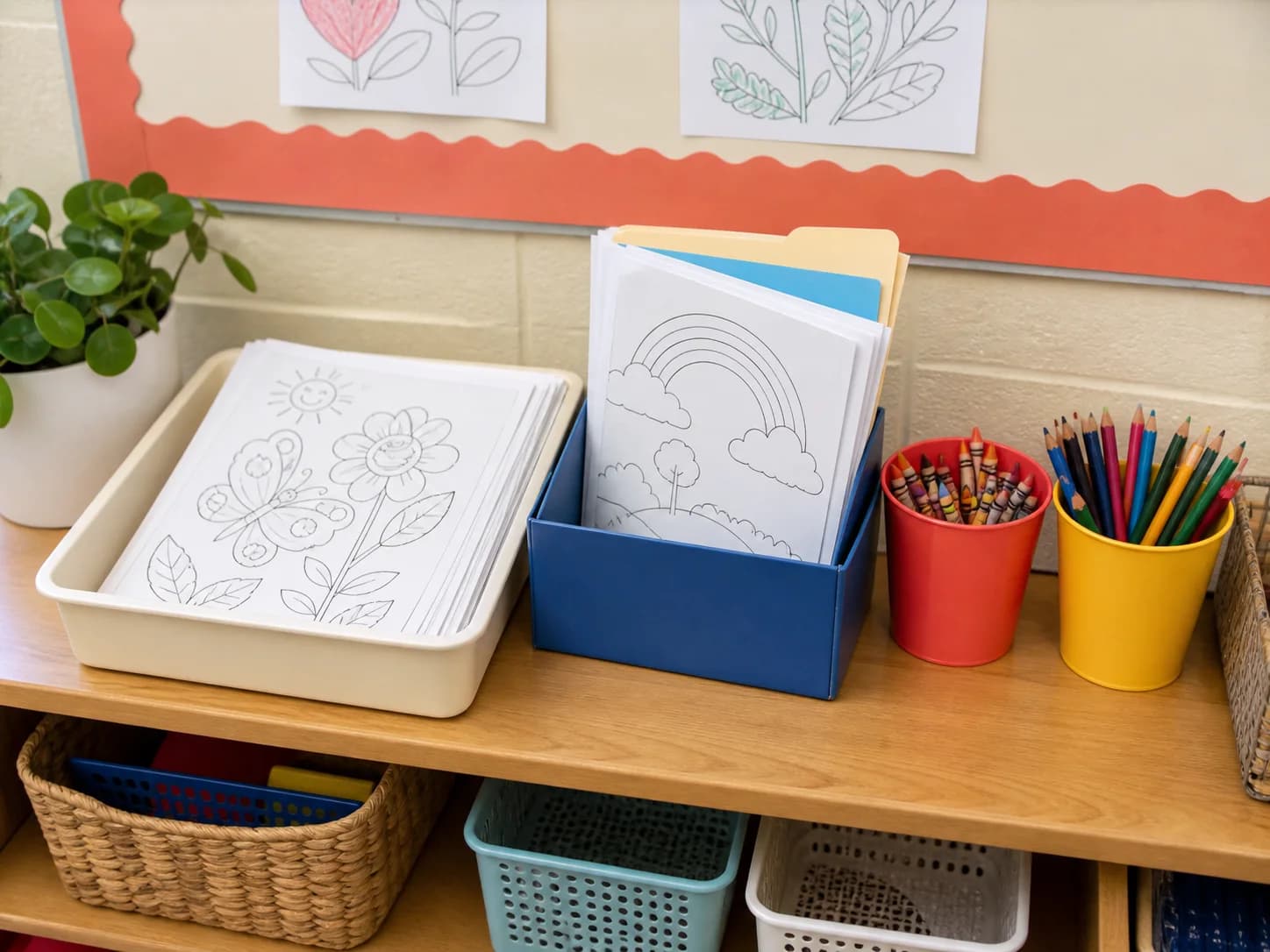
Keep the physical setup small enough that students can understand it at a glance. One tray for fresh pages, one folder or file for work in progress, and a limited set of coloring tools are enough. Place the station where a student can reach it without crossing the teaching area or opening a crowded supply cabinet.
- Print one master test before making copies so margins and line quality are known.
- Avoid putting every supply on the table. Add markers only when the paper, surface protection, and cleanup routine support them.
- Keep high-interest pages available to everyone during another block too, so early finishing is not the only path to them.
| Part | What to include | Why it helps |
|---|---|---|
| Fresh choices | Three to five designs with varied subjects and detail | Students can choose without sorting through a large pile. |
| Works in progress | One class file, table folders, or individual unfinished-work folders | A transition does not create pressure to finish the whole page. |
| Dry materials | Small containers of crayons and colored pencils | They are predictable, quiet, and easier to clean than wet supplies. |
| Blank paper | A small stack in the same area | Students who prefer original drawing can use the same routine. |
| Cleanup check | A simple visual showing return page, return tools, check floor | The station can reset without a teacher reminder. |
Teach the routine before students need it
Model the sequence with the whole class when nobody is waiting. Show a completed assignment, demonstrate the expected self-check, walk to the station, choose a page, begin, hear the transition signal, and store the unfinished page. Keep the model short, then let several students practice the movement while everyone notices what made it work.
A useful verbal routine is: finish, check, choose, store. The first two steps protect the quality of the assigned work. The last two make the next activity independent and interruptible.
- Finish the assigned task and use the class check routine.
- Complete any required correction or unfinished item first.
- Choose one available early-finisher option without asking for a new direction.
- Work at the agreed voice level and keep materials in the station area.
- At the transition signal, put the page in the finished or unfinished location and return every tool.
Offer choices that fit the time available
Students do not need to complete a full page for the choice to be worthwhile. Match the invitation to the likely time window and make saving work normal. A page with larger regions may suit a short transition, while a detailed scene works better for a recurring quiet-time folder.
| Time available | Useful page or prompt | Stopping point |
|---|---|---|
| About 3-5 minutes | One large subject, broad regions, add one color pattern | Finish one region and store the page |
| About 5-10 minutes | Simple scene with two or three subjects | Complete the main subject or add one original detail |
| About 10-20 minutes | Detailed scene connected to a book or unit | Choose a natural section and mark where to continue |
| Recurring folder | Advanced page, visual puzzle, or student-designed scene | Return it to the same folder across several sessions |
Use prompts that add choice without adding a worksheet
A short prompt can deepen the page without turning it into another graded task. Invite students to add something the character needs, create a repeating color pattern, draw what is outside the frame, label one object, or change the setting for a different season. Keep the prompt optional unless it serves a planned lesson goal.
Rotate pages without creating weekly prep work
Choose one dependable evergreen set, then replace only one or two designs at a time. A full refresh every Monday creates unnecessary printing and teaches students to wait for novelty. A slow rotation also makes it easier to notice which detail levels and subjects are actually used.
- Keep two evergreen choices such as animals, transportation, gardens, or imaginative scenes.
- Add one page connected to the current read-aloud, science topic, community study, or classroom question.
- Add one seasonal page only when it fits the class calendar and community.
- Retire pages that remain untouched for two rotations and keep the successful masters.
- Print small replacement batches rather than a full class set of every design.
Keep the routine inclusive
Do not assign page difficulty publicly by age, reading group, or perceived ability. Let students choose among broad, moderate, and detailed designs. A child may want a simple page after a demanding task or a complex page because the subject matters deeply to them.
Provide a blank-page option and allow a student to continue a saved design rather than start a new one. Use adaptive grips, larger crayons, a clipboard, a quieter seat, or reduced visual choices when those supports are already part of a student's classroom access. Coloring should not be required from a student who finds the activity uncomfortable or uninteresting.
Make the same attractive materials available during centers, indoor recess, art choice, or another class block. This reduces the incentive to rush and gives students who work slowly access to the same creative option.
Review the system after one week
Watch the transitions rather than judging the artwork. The important questions are whether students know when they may choose, can locate materials, begin without interrupting instruction, stop when asked, and restore the station for the next person.
- Are students rushing or skipping the assigned self-check? Strengthen the finish routine before changing the choices.
- Does the station create traffic? Move materials closer to the students who use them or reduce the number of open containers.
- Are pages abandoned after one minute? Offer fewer designs with clearer differences in subject or detail.
- Do students resist stopping? Practice storing unfinished work and give a specific transition warning.
- Is one student using all the copies? Set a one-page-at-a-time norm and restock from a master only as needed.
Frequently asked questions
Should early finishers have to complete the coloring page?
No. The routine should include a normal place for unfinished work. Requiring completion can make a calm choice feel like another assignment and can create resistance at transition time.
How many coloring pages should I offer at once?
Three to five is usually enough to create meaningful choice without making the station hard to scan or restock. Vary subject and detail, then rotate one or two designs at a time.
Does coloring reward students for rushing?
It can if high-interest pages are available only to early finishers. Require a clear self-check, offer other choices, and make coloring available during another class period so speed is not the only route.
What if a student does not want to color?
Offer alternatives such as reading, blank-paper drawing, continuing unfinished work, or another approved extension. A consistent menu is more inclusive than one required early-finisher activity.