
Quick answer
Choose one recurring trouble spot rather than mapping the entire day. Make a short row of cards with photos or drawings the child connects to the real activities. Place the sequence at the child's eye level, model how to check it, and let the child move each completed card to a finished pocket or envelope.[2] If two steps are enough, use a first/then board. Keep the order consistent enough to be predictable, follow through, and explain unavoidable changes calmly.[3]
- Start with one transition, such as getting out the door, arriving at class, cleanup, or bedtime.
- A schedule shows the larger order of activities. A routine explains the smaller steps used to complete one activity.[1]
- Use a few recognizable cards and place them where the sequence happens, at the child's eye level.[2]
- Teach the tool by modeling, pointing, moving cards, and following the sequence together.[2]
- Make changes visible and explain them in advance when possible rather than expecting rigid compliance.[1][3]
Choose one trouble spot, not the whole day
Begin with the moment when spoken reminders pile up. At home, that might be the stretch from waking to leaving, the return from school, or the steps before bed. In a preschool or daycare room, it might be arrival, handwashing before lunch, cleanup, or getting ready for outdoor play. Simple routines are easier to use, and the plan should fit what the child can currently do.[3]
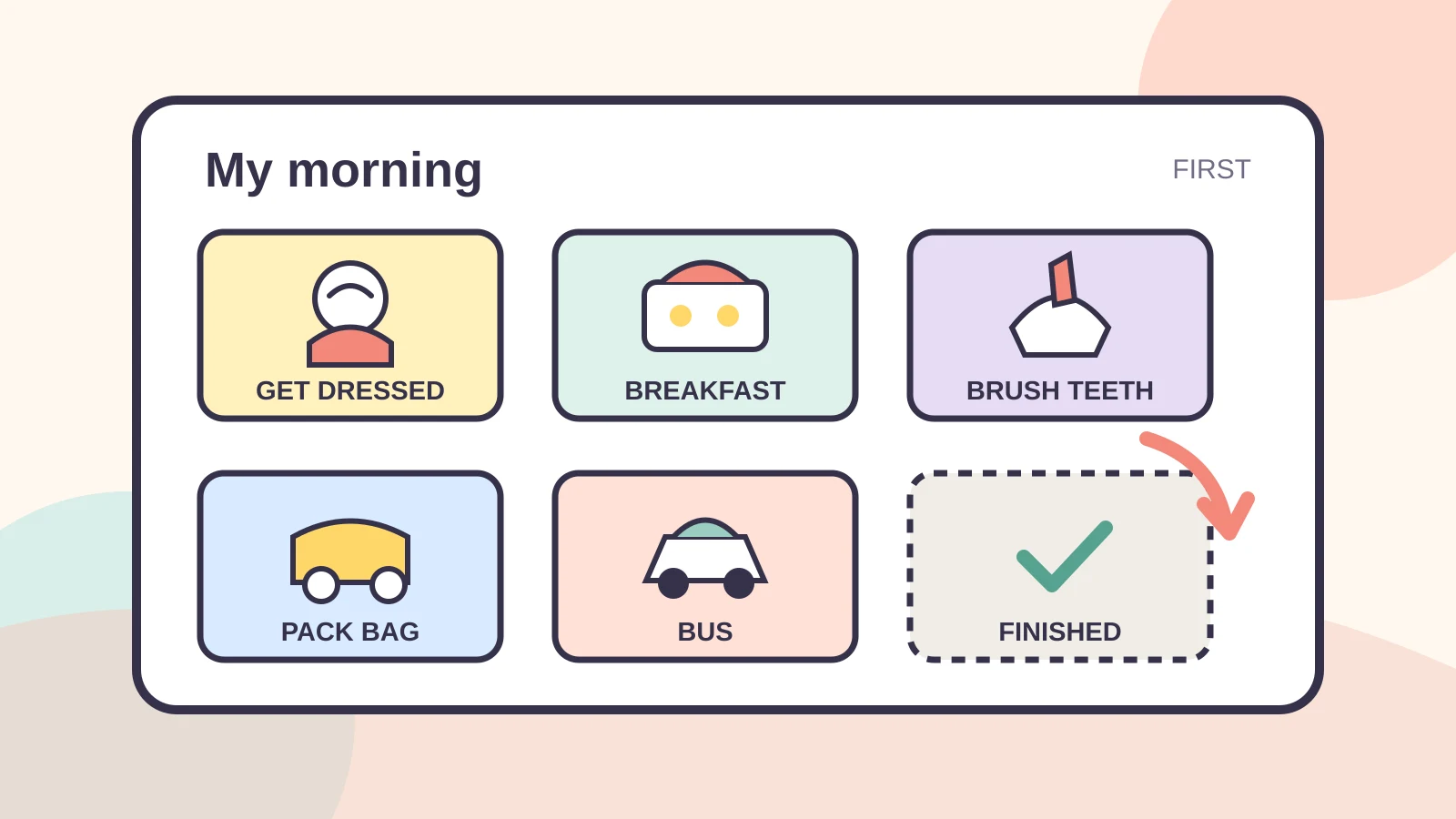
Write down what actually happens during that small window. If leaving home is the problem, the sequence might be toilet, clothes, breakfast, teeth, bag, and bus. If cleanup is the problem, the sequence might be stop signal, toys in bins, check the floor, and meet on the rug. For the first version, keep only the cards needed for the immediate job. A short sequence is also easier for adults to follow consistently.[3]
Do not add every desirable behavior. Put on socks and put cup in sink may matter, but they do not both belong on a chart unless they are necessary parts of the selected trouble spot. The first goal is not to document the day. It is to create one sequence that the child and adult can use together.
Know whether you need a schedule or a routine
A schedule is the big picture. It shows which activities happen and in what order, such as arrival, breakfast, play, cleanup, and outside time. A routine is the repeatable process inside one of those activities, such as hang coat, put lunch away, wash hands, and choose a table activity. Head Start distinguishes schedules from routines this way and recommends making both predictable while keeping room for flexibility.[1]
This distinction prevents overcrowded charts. A classroom schedule might use one card for lunch. A separate lunch routine can show wash hands, find seat, eat, clear place, and throw away trash. At home, bedtime can be one card on an evening schedule, while the bedtime routine has its own short strip for pajamas, teeth, book, and bed.
Choose the level that matches the problem. If the child asks what comes after snack, use a schedule. If the child reaches bedtime but gets lost between the bathroom and bed, show the bedtime routine. Review the relevant visual each day rather than assuming that posting it once has taught its meaning.[1]
Choose pictures the child recognizes
The best image is not always the prettiest one. Use a photo or drawing that clearly refers to the child's real activity. The National Center for Pyramid Model Innovations suggests drawing a missing card, attaching a photo, or using a picture from a magazine.[2]
For a home-to-school sequence, photograph the child's actual bus instead of choosing a generic yellow bus that looks different. Use the actual classroom door, including its color or familiar sign, for the arrival card. For bedtime, photograph the child's bedtime book basket rather than using a general image of a library. Crop out unrelated background details and add one short label if the adults want printed words beside the image.
A child may draw the pictures or help choose between two images. Coloring the cards can be an optional preparation activity, but it is not required and should not delay using the schedule. If a clean drawing would be easier to recognize than a busy photo, ColorKind, a free-to-try app for turning a photo or written idea into a printable coloring page, is one possible way to make it. The useful part is the familiar subject, not whether the child colors it.
Build the cards and put them in the right place
Arrange the cards from top to bottom or left to right. Pick one direction and keep it consistent. Attach the cards with reusable fasteners, clips, magnets, or pockets so the child can interact with them. Place the display at the child's eye level in the area where the routine begins, rather than high on a refrigerator or classroom wall where only adults can comfortably reach it.[2]
Add an obvious finished location. This can be an envelope, a pocket, a small box, or a marked section at the end of the strip. After each activity, the child removes the card and puts it in the finished place. An active finished marker lets the child participate in the sequence and see what remains.[2]
Keep the mechanics easy. If a fastener takes two hands and adult strength, replace it. If loose cards vanish, connect them with tabs or store duplicates nearby. If the child is distracted by all the pictures at once, cover later cards and reveal them as needed. The form should fit the child's current capability, while the adult keeps the order and expectations consistent.[3]
- Choose one trouble spot and list the essential steps.
- Select photos or drawings the child recognizes.
- Arrange them in one clear reading direction.
- Place the schedule at the child's eye level where the routine begins.[2]
- Add a finished pocket, box, or marked area the child can use.[2]
Teach the schedule by using it together
Do not introduce the chart with a long explanation. Stand beside it before the first activity and say, "Check the schedule." Point to the first card, name the activity, and begin it together. When the step is complete, model moving the card to finished. Then point to the next card. Teaching through modeling and repeated use shows the child what the visual is for.[2]
During the first several uses, expect to prompt the process. The adult might point, help the child remove a card, or move it while the child watches. Reduce that help when the child begins checking or moving cards independently. Continue to follow the displayed order whenever possible. Consistency, predictability, and adult follow-through make the chart dependable.[3]
Use neutral, concrete language. Try, "Shoes are finished. Put the shoe card in the pocket. Next is bag." Avoid turning every check into a quiz such as, "What are you supposed to do now?" The schedule is meant to provide information. It should not become another task the child can answer incorrectly.
Use a first/then board when the full strip is too much
Some moments need only two pieces of information. A first/then board shows the immediate step and what follows it. For example: first toilet, then pajamas; first blocks in bin, then playground; first coat, then bus. First/then visuals can present a short sequence without displaying the rest of the day.[2]
Choose a "then" activity that is genuinely scheduled to happen. Do not show playground if weather or staffing makes it unlikely. Follow through with the second card after the first step is complete, since follow-through helps make routines predictable.[3] If the plan must change, replace the card and calmly explain what will happen instead.[3]
A first/then board is also useful when a child is learning to check visuals. Once the child can use two cards with support, add another step only if more information would help. More cards are not automatically better. The number and kind of steps should fit the child's capabilities.[3]
Show changes without making the schedule rigid
A visual schedule should make the day understandable, not promise that nothing will ever change. Head Start recommends flexibility and advance warning when a schedule or routine will be different.[1] Review the day's plan and point out a substitute teacher, appointment, indoor recess, different pickup adult, or skipped activity before reaching that part of the sequence whenever possible.[1]
Make the change visible. Remove the canceled card, turn it over, or cover it with a simple change symbol. Put the replacement card in its real position. Then use a short explanation: "The playground is wet. First snack, then indoor play." Calmly explaining a change and stating what will happen preserves some predictability even when the original plan cannot continue.[3]
Do not secretly leave an inaccurate card in place because changing it may cause disappointment. The child needs the visual to match adult follow-through.[3] Acknowledge the reaction without debating it: "You expected outside. Today it changed." Then return attention to the updated next step.
Adapt the same idea between school and home
Home and school visuals do not need identical artwork, but shared language can reduce guesswork. A teacher might send home the same simple terms used for arrival, such as hang bag, wash hands, and choose a center. A family might tell the teacher that the child understands "finished pocket" or already uses a first/then board. Personalized pictures and consistent modeling can help each visual connect to the setting where it is used.[2][3]
Keep setting-specific details. The school arrival card should show the actual classroom door, while the home card can show the child's actual bus or pickup place. A classroom rest routine and a home bedtime routine may both use a book image, but the bedtime card can show the child's bedtime book basket. Familiar photos and drawings can be selected for the individual child.[2]
If the hardest transition begins after pickup, pair the arrival visual with a short plan for food, belongings, and a settling activity. Keep that chart separate from the classroom schedule so each one answers the child's immediate question about what happens here.
Troubleshoot the schedule before adding more reminders
If the child ignores the chart, first check access. Is it at eye level? Can the child reach and move the cards? Were the pictures explicitly modeled? Do they resemble the real objects and places? Is the displayed order the order adults actually follow? Eye-level placement, active use, individualized images, and adult modeling are all parts of teaching a visual routine.[2]
If the child removes every card at once, hand over one card at a time or cover the later steps. If the child argues when a preferred activity ends, add a clear next card and review the sequence before the transition.[1] If adults keep skipping steps, shorten the routine until they can follow it consistently.[3] If one picture is repeatedly misunderstood, replace it with a clearer photo or drawing.[2]
If the schedule worked last month and now creates friction, check whether the activities, order, or level of support still fit. Routines should match a child's current skills and capabilities, and schedules need room for change.[1][3] Remove mastered details, add support where the child is getting lost, and test one revision at a time.
| What happens | Check first | Try next |
|---|---|---|
| The child never looks at it | Placement and modeling | Move it to eye level and practice one step together.[2] |
| The pictures cause confusion | Recognition | Use a photo or drawing tied to the real activity.[2] |
| The child stops after one card | Adult follow-through | Prompt the finished marker, then point to the next card.[2][3] |
| Changes cause conflict | Advance warning | Update the card and explain the new plan calmly.[1][3] |
| Adults forget to use it | Length and location | Reduce it to the essential steps and place it where the routine begins.[3] |
Know when the plan needs individualized help
Ask for individualized support when repeated modeling, clearer pictures, fewer steps, and consistent follow-through still do not make the routine usable, or when the routine regularly becomes unsafe or overwhelming. Bring specific observations to the people who know the child in that setting. A family can ask the teacher what cues work at school. A teacher can ask the family which objects, words, and pictures the child recognizes at home.
Describe what happens rather than labeling the child. Note the routine, the displayed cards, the prompts given, the point where participation stopped, and what helped the child rejoin. This information can help a teacher, early childhood specialist, or qualified health professional consider whether the visual needs a different format or whether the child needs broader support. Any plan should fit the child's abilities rather than requiring the child to fit a generic chart.[3]
A visual schedule is one communication and teaching tool. Keep it when it makes the next step clearer. Simplify or replace it when it does not. The aim is a routine that the adults can follow and the child can understand, including on days when the order changes.[1][3]
Frequently asked questions
How many pictures should a visual schedule have?
Start with only the cards needed for one trouble spot. If that is still too much information, use a first/then board and add cards only when they would help. The routine should be simple and suited to the child's current capabilities.[2][3]
Should I use photos or drawings?
Use whichever the child most clearly connects to the real activity. A photo of the actual place or item may work well, while a simple drawing can remove distracting details.[2]
What should I do if my child refuses to check the schedule?
Check whether it is reachable, recognizable, and accurate. Move it to eye level, model one step without quizzing, help the child place that card in finished, and follow the displayed sequence.[2][3]
Will changing the schedule ruin the routine?
No. Schedules should be predictable but flexible. Show the changed card, give advance warning when possible, and calmly explain what will happen instead.[1][3]
When should I ask a teacher or professional for help?
Ask for individualized help when the child still cannot use the routine after you have simplified the steps, clarified the pictures, modeled the process, and used it consistently, or when the routine regularly becomes unsafe or overwhelming. Share concrete observations so the support can be matched to the child.