
Quick answer
Try this: "Labor Day is a day when we recognize workers and the work they do. Labor activists pushed for the holiday because they wanted workers' contributions to be seen." Labor Day is observed on the first Monday in September; in 2026, that is Monday, September 7.[1] For younger children, stop there and name familiar workers. Older children can add the short history, study a historical photograph, or interview someone about a real day at work.
- Lead with what the holiday honors, not with sales, picnics, or the end of summer.
- Describe workers by what they do and who depends on that work, not by costumes or stereotypes.
- Teach a few solid dates: the first celebration was in 1882, Oregon passed the first state law in 1887, and Congress established the federal legal holiday in 1894.[1]
- Use questions children can investigate: What work is happening? What tools and skills does it require? What would stop working if nobody did it?
- Choose one or two activities that fit the group. A full themed day is not necessary.
Start with a sentence that fits the child's age
For preschoolers and early elementary children, say: "Labor Day is a day to notice and thank the people whose work helps our community." Then ask for examples. Children may name a teacher, bus driver, nurse, cook, farmer, mechanic, sanitation worker, librarian, delivery driver, or someone in their family. The list does not need to be complete. Its job is to turn the word worker into people and actions the child recognizes.
For older elementary children, add: "The holiday began after workers and labor activists asked for a day that recognized workers' contributions." The U.S. Department of Labor describes Labor Day as an annual celebration of the social and economic achievements of American workers.[1] Translate social and economic into ordinary language: workers help communities function, create goods and services, care for people, and earn money for their work.
Let the explanation get more detailed when the child asks for more. A five-year-old may be satisfied after identifying who drives the school bus. A ten-year-old may ask who decided the holiday was needed or why some workplaces were unsafe. Both conversations are valid. You can answer the question in front of you without reducing the holiday to costumes or overwhelming children with more history than they are ready for.
| Age or stage | Words to try | Good next question |
|---|---|---|
| Preschool | Labor Day is a day to notice workers and the jobs they do. | Who worked to help us today? |
| Early elementary | Labor Day recognizes the work people do for families and communities. | What would be different if nobody did that job? |
| Later elementary | Workers organized for a holiday that would recognize their contributions. | Why might workers want their work to be seen and respected? |
Tell the short, accurate history
Labor Day grew out of the late-nineteenth-century labor movement, when labor activists pushed for a federal holiday that recognized workers' contributions.[1] The first celebration took place in New York City on September 5, 1882. Oregon became the first state to pass a Labor Day law in 1887. Other states followed, and Congress established Labor Day as a federal legal holiday in 1894.[1] Those three dates are enough to show that the holiday grew over time rather than appearing all at once.
The founder question is less tidy. Historical records credit either Peter J. McGuire, a carpenter and labor leader, or Matthew Maguire, a machinist and union secretary. The Department of Labor says both men have a credible claim.[1] That uncertainty can be useful with older children: history is built from records, and records do not always settle every question.
Early proposals paired a street parade of trade and labor organizations with a festival for workers and their families.[1] That helps explain why modern observances can include both recognition and recreation. A cookout is not the meaning of Labor Day, but rest and time with family fit the holiday's early traditions.
Talk about work without shrinking it to uniforms
Community-helper units often favor jobs with easy props: a firefighter's helmet, a doctor's stethoscope, a chef's hat. Those are useful starting points, but many workers do not wear a recognizable uniform. Add people who stock shelves before a store opens, repair heating systems, translate documents, design bridges, process payroll, clean classrooms, grow food, write software, care for relatives, or run a small business.
Ask what the person does before asking what the job is called. The same tool can belong to several occupations, and one occupation can include many duties. A measuring tape may be used by a carpenter, tailor, stage designer, or engineer. A computer may help a teacher plan a lesson, a dispatcher coordinate vehicles, or a graphic designer make a sign. Accept more than one answer when the child can explain it.
Avoid saying that every worker is a helper or hero. Work can be valuable without turning each occupation into a character type. Use concrete language instead: this person repairs water pipes; this person prepares school lunches; this person keeps records accurate. Also avoid asking a child to disclose a parent's job, schedule, or employment status. Children can talk about any worker they know or choose a public place to study.
Activity 1: Map the work behind one familiar place
Choose one place the group knows well: a school, library, grocery store, apartment building, park, clinic, or bus stop. Draw the place in the middle of a large sheet. Around it, add the workers whose labor keeps it functioning. A school map might include teachers, office staff, classroom aides, custodians, cafeteria workers, bus drivers, crossing guards, nurses, maintenance crews, and delivery workers.
For each person, add a verb rather than only a job title: plans, teaches, cleans, repairs, orders, cooks, drives, checks, or delivers. Then ask, "Who works here before we arrive or after we leave?" This catches less visible labor without pretending the class can name everyone. Leave blank spaces for workers the group discovers later.
Finish with one chain of dependence. The cafeteria needs ingredients; a delivery worker brings them; food service staff store and prepare them; someone maintains the refrigerator; custodians clean the room afterward. The point is not that every child memorizes the chain. It is that familiar places depend on many kinds of work happening together.
Activity 2: Match occupations to real duties
The U.S. Bureau of Labor Statistics offers a young-student activity that matches occupations with job descriptions.[4] You can borrow that structure without using a large worksheet. Write four occupations on cards and four short descriptions on separate cards. Read each duty aloud and ask children to show what evidence helped them match it.
Use duties that contain real information. "I care for the health of animals and treat injuries" is more useful than "I love pets." "I plan routes and bring packages to homes and businesses" says more than "I drive a truck." For children who are not reading yet, show an object or act out one safe motion, then describe the rest of the job aloud.
After matching, change one card. Ask whether the same worker has other duties or whether another occupation could perform something similar. This prevents a one-prop-one-job lesson. It also opens a better question for Labor Day: what knowledge, practice, tools, and cooperation does the work require?
Activity 3: Read a historical work photograph
The National Archives' Labor Day collection includes photographs of foundry workers, pharmacists, riveters, welders, agricultural workers, medical staff, firefighters, and other workers.[2] Choose one image with details children can study. Show the photograph without explaining it first.
Use three passes. First, observe: list only what is visible, such as clothing, tools, body positions, materials, and the setting. Second, reflect: what might be happening, and what visible clue supports that thought? Third, question: what would we need to learn before deciding? The Library of Congress recommends an analysis process built around observing, reflecting, questioning, and investigating further.[3]
Compare the historical image with a current photograph of similar work. Look for changes in tools, protective equipment, clothing, or surroundings. Do not ask children to guess whether one worker was happy, poor, or treated fairly from a face or pose. A photograph is evidence, but it does not answer every question. The missing information is part of the lesson.
Activity 4: Interview a worker with care
Invite a family member, school employee, or community guest to describe one ordinary workday. Send the questions ahead of time so the guest can skip anything private. Ask: What do you do first? What tools or skills do you use? Who relies on your work? What is harder than it looks? What is one thing you wish children understood about the job?
Do not ask guests or children to disclose personal wages, immigration status, layoffs, or family schedules. Children can still explore general questions about pay, safety, working hours, and worker rights through books, photographs, or public historical sources. If no guest is available, use a recorded oral history from a library or interview a school worker who has agreed to participate.
Close with a specific thank-you rather than a generic card. A child might write, "Thank you for checking the playground gate before we go outside," or dictate, "Thank you for fixing the library books so we can keep reading them." Specificity shows that the child noticed the work, which is closer to the purpose of Labor Day than decorating a page with job symbols alone.
Use coloring as an optional extension
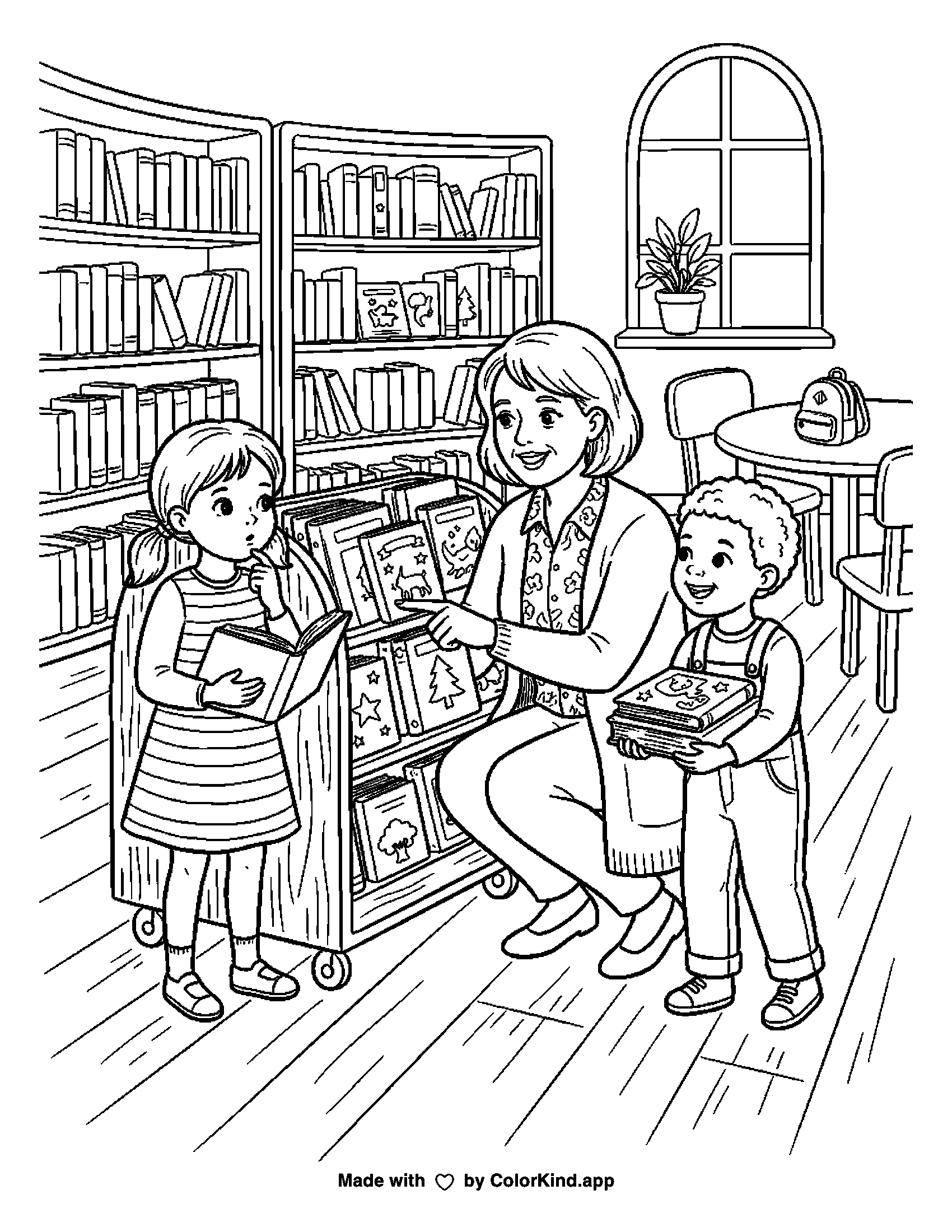
A coloring page can support the discussion when it gives children something specific to inspect or add to. Choose a scene that shows work in context, then ask children to circle a tool, label an action, or draw one missing worker at the edge. The conversation should still carry the lesson; coloring is one way to stay with the image, not proof that the child understood it.
For a worker the group actually knows, you could use ColorKind, a free-to-try app that turns a photo or written idea into a printable coloring page, to make a scene with the school custodian checking a sink, a baker preparing dough before sunrise, or a librarian repairing a torn book. Ask permission before using someone's photo. A written idea works when a worker would rather not be photographed.
Add one sentence below the finished page: "This worker helps our community by ___." Let the child supply a verb and a concrete detail. Keep the page with the work map, interview notes, or photograph observations so it belongs to the larger inquiry instead of becoming a stand-alone holiday craft.
A 30-minute Labor Day lesson plan
A short lesson is enough. Use five minutes for the age-appropriate explanation and timeline. Spend ten minutes mapping the work behind one familiar place. Use another ten minutes for either the duty match or one historical photograph. Save the final five minutes for children to name one thing they noticed and one question they still have.
If you have more time, interview a worker on another day. If you have less, keep the opening sentence and one photograph. Do not cram four activities into a single preschool circle time. The goal is for children to leave with an accurate answer to "What is Labor Day?" and a more detailed view of work around them.
Return to the opening question at the end: "What does Labor Day recognize?" Listen for workers and work, not a memorized list of occupations. A child who says, "It is a day to notice the people who do work we need, even when we do not see them," has the central idea.
Frequently asked questions
What is Labor Day in simple words?
Labor Day is a U.S. holiday that recognizes workers and their contributions. It is observed on the first Monday in September.[1]
When is Labor Day in 2026?
Labor Day is Monday, September 7, 2026. The date changes each year because the holiday is always on the first Monday in September.[1]
Who started Labor Day?
The record is disputed. Peter J. McGuire and Matthew Maguire both have credible claims, according to the U.S. Department of Labor. The first Labor Day celebration took place in New York City in 1882.[1]
Is Labor Day the same as Memorial Day?
No. Labor Day recognizes American workers and their contributions. Memorial Day honors people who died while serving in the U.S. military.[5]
How can I teach Labor Day without a long history lesson?
Give one clear explanation, map the workers behind a familiar place, and choose either a job-duty match or one historical photograph. Ask children what they notice and what they still want to know.[2][3][4]
Sources and further reading
- [1] U.S. Department of Labor: History of Labor Day
- [2] National Archives: Labor Day records and selected images
- [3] Library of Congress: Teacher's Guides and Analysis Tool
- [4] U.S. Bureau of Labor Statistics: Guess My Occupation activity
- [5] U.S. Department of Veterans Affairs: VA Remembers America's Fallen on Memorial Day